
Summary:
You’ve already decided the roof needs to go. Now comes the part nobody prepares you for — figuring out which material is actually worth your money. Metal roofing sounds appealing. Architectural shingles are familiar. And every contractor seems to have a different opinion, usually one that lines up conveniently with whatever they happen to sell.
Here’s what we’ve learned after 40 years of roofing homes across Monmouth County: there’s no single right answer. But there is a right answer for your situation. This breakdown will help you figure out which one that is.
Metal Roof vs Shingles Price: What Monmouth County Homeowners Actually Pay
The cost gap between these two materials is real, and it’s significant. In Monmouth County, architectural shingles typically run $5.50 to $9.50 per square foot installed. Metal roofing — depending on the type — runs $12 to $20 per square foot.
On a 2,000-square-foot home, that translates to roughly $11,000 to $19,000 for architectural shingles versus $24,000 to $40,000 or more for metal. That upfront difference is what stops most homeowners from seriously considering metal. But the full picture is more nuanced than sticker price alone.
If you plan to stay in your home for decades, the math shifts considerably — and we’ll get into that below.
Metal Roofs for Homes: Does the Long-Term Cost Actually Work Out?

Here’s the part most people don’t think through: a $35,000 metal roof that lasts 50 years costs you about $700 per year. A $22,000 architectural shingle roof that lasts 27 years costs about $815 per year. Over a long enough horizon, metal is actually the less expensive option — even though it costs nearly twice as much upfront.
That math only works in your favor if you’re staying. If you’re planning to sell within 10 to 15 years, the return on a metal roof at resale doesn’t meaningfully outpace what you’d get from a quality shingle roof. Both materials recoup somewhere in the range of 60 to 70 percent of their cost at sale, according to national cost-versus-value data.
The gap isn’t nearly as wide as the price difference suggests. There’s also the Monmouth County climate factor to consider. Architectural shingles last 25 to 30 years nationally — but in our area, that lifespan sits toward the lower end of that range.
The freeze-thaw cycles through winter, the coastal salt air in towns like Sea Bright, Belmar, and Manasquan, and the summer UV load all accelerate wear in ways that milder climates simply don’t. Metal holds up better under those conditions, which is part of why it carries a 40 to 70-year lifespan even in demanding environments.
It’s also worth noting that steel tariffs in 2026 have pushed metal roofing costs up roughly $1.50 to $2.50 per square foot compared to 2024 pricing. If you’ve been putting off the decision, that’s a real factor in your current quote.
One more thing: New Jersey code does not allow a third layer of roofing material. If your home already has two layers of shingles, a full tear-off is required regardless of which material you choose. That adds to the project cost on both sides, and it’s something to ask about during your estimate.
How Long You're Staying Is the Real Question
We’re going to be direct with you: for most Monmouth County homeowners, architectural shingles are the right answer. They’re practical, proven, and cost-effective — especially if you’re not planning to stay in the home for 20 or more years.
Roughly 85 to 90 percent of residential roof replacements in New Jersey use architectural asphalt shingles, and there’s a reason for that. The upfront cost is manageable, the installation is faster, repairs are straightforward, and the materials perform reliably through New Jersey winters when installed correctly.
Metal becomes the stronger choice in specific situations. If you’re in a home you intend to keep long-term, if you’ve had persistent ice dam or winter performance issues, or if you’re in a coastal Monmouth County community where salt air accelerates wear on traditional materials, metal’s durability advantage starts to justify the premium.
Homeowners in inland communities like Colts Neck, Holmdel, or Manalapan deal with different conditions than those right on the water, and the decision should reflect that. There’s also the HOA question. A number of communities in Monmouth County — particularly in Manalapan, Marlboro, and Tinton Falls — have covenants that specify permitted roofing materials.
Some explicitly require architectural shingles on street-facing slopes and restrict exposed metal panels. It’s worth checking your CC&Rs before you commit to a material, because finding out after the estimate is a frustrating detour.
One factor that often gets overlooked: insurance. Carriers in New Jersey are increasingly scrutinizing roofs over 20 years old. Some won’t renew a policy or will reduce coverage on an aging roof — and in a county that sees the storm activity Monmouth County does, that’s not a theoretical risk. Metal’s longer lifespan reduces your exposure to that scenario over time.
Types of Metal Roofing: What's Actually Available and What It Costs
If you’re leaning toward metal, it helps to understand that “metal roof” isn’t one thing. There are several distinct types, and they vary meaningfully in cost, appearance, and performance. The choice between them matters — both for your budget and for how the finished roof will look on your home.
The three options most commonly installed on residential homes in Monmouth County are standing seam, stone-coated steel, and corrugated metal. Each has a different profile, price point, and practical fit depending on the property.
Standing Seam vs Stone-Coated Steel: Which Metal Roof Is Right for Your Home?
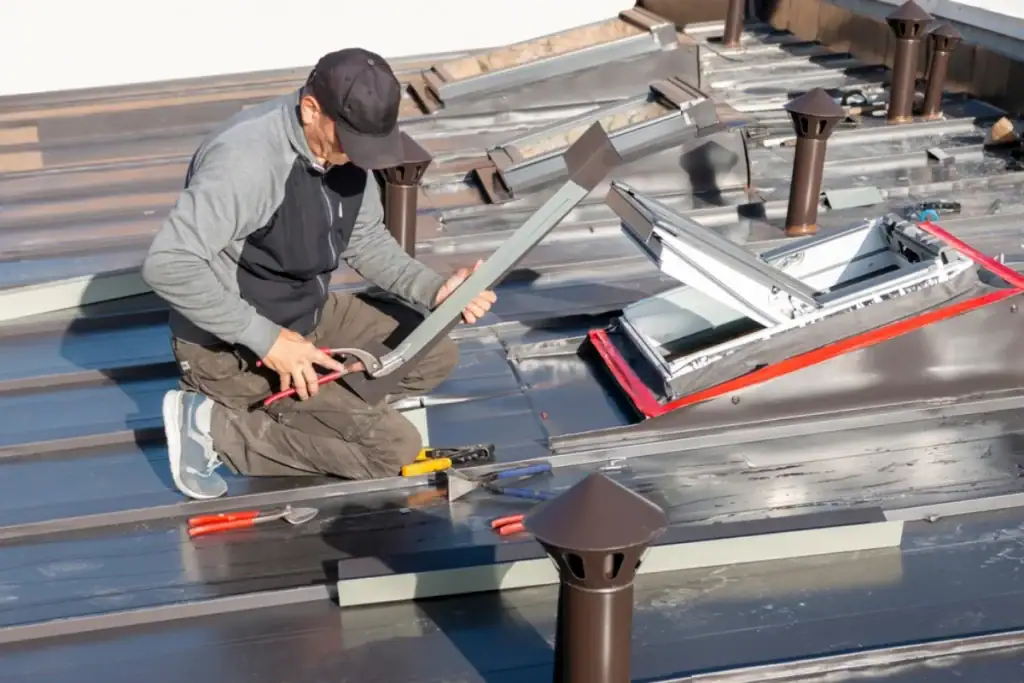
Standing seam is what most people picture when they think of a metal roof — long vertical panels with raised seams and hidden fasteners running from ridge to eave. It’s clean, modern, and extremely durable. The hidden fastener design eliminates exposed penetrations, which is one of the reasons standing seam performs so well in high-wind environments.
In Monmouth County, where nor’easters can push sustained winds for hours at a stretch, that matters. Standing seam typically runs $10 to $18 per square foot installed, putting it at the higher end of the metal roofing range.
Stone-coated steel is worth understanding because it directly addresses the two biggest objections most homeowners have about metal: it looks like a traditional roof, and it doesn’t sound like a drum in a rainstorm. The process starts with steel panels that are rolled into shape and then coated with stone granules — the same granule texture you’d find on asphalt shingles.
The result is a roof that can convincingly mimic the look of wood shake, clay tile, or dimensional shingles, while still delivering the lifespan and wind resistance of metal. Stone-coated steel typically runs $9 to $13 per square foot installed, making it a middle-ground option between architectural shingles and premium standing seam.
Corrugated metal — the exposed-fastener style — is the most affordable metal option at roughly $6 to $10 per square foot, but it’s less common on residential homes in Monmouth County. It’s more frequently seen on agricultural buildings or outbuildings, and the exposed fasteners create more long-term maintenance points than the other options.
Why the Installer Matters as Much as the Material You Choose
Over 80 percent of roof leaks trace back to installation errors, not material defects. That single statistic reframes the entire metal-versus-shingles conversation. You can buy the best architectural shingles on the market, have them installed by a crew that cuts corners on flashing or skips the underlayment step, and end up with a roof that fails in year seven.
The material doesn’t save you from a bad install. This is where GAF certification actually means something. Only about 3 percent of roofing contractors nationwide qualify for GAF certification, and it requires meeting strict standards for business practices, training, and customer service.
More importantly, it unlocks warranty tiers that uncertified contractors simply can’t offer — including enhanced warranties that cover both materials and labor, not just the shingles themselves. GAF’s WindProven warranty, available on qualifying systems installed by certified contractors, is the only shingle warranty in the industry with no maximum wind speed limit.
For a home in Monmouth County that’s going to face nor’easters for the next three decades, that’s not a marketing footnote. At A Russo Roofing & Siding, the owner is present at every job site. Not a foreman relaying instructions — the owner, on your roof, checking the work.
Flashing gets replaced, not reused. Underlayment goes down before a single shingle is nailed. The decking gets inspected and repaired if needed. Warranty registration is completed properly, because a warranty that isn’t registered isn’t worth much when you need it. When the crew leaves, the property gets walked with a magnet to pick up every nail.
That process is why we back our roofing work with a 30-year labor warranty and a 20-year workmanship guarantee. Most local contractors offer 10 to 15 years. The difference isn’t marketing — it’s confidence in how the work is done.
Which Roofing Material Is Right for Your Monmouth County Home?
For most homeowners in Monmouth County, architectural shingles are the practical, cost-effective choice — especially if you’re not planning to stay in the home for 20 or more years. Metal roofing earns its premium for long-term owners, coastal properties dealing with salt air, and homeowners who want to avoid a second replacement within their ownership window.
What neither option can overcome is a bad installation. The material matters, but who puts it on — and how — is what determines whether your roof actually performs the way it’s supposed to.
If you’re ready to figure out which direction makes sense for your home, A Russo Roofing & Siding offers same-day free estimates with no pressure and no runaround. We’ll tell you honestly whether a repair will handle it or whether replacement is the right call. Reach out and we’ll come take a look.