
Summary:
Your ceiling is stained. Water is dripping somewhere it shouldn’t be. Maybe you just walked outside after a storm and saw shingles in your yard. Whatever triggered it, you’re now dealing with a roofing emergency — and you need answers fast, not a sales pitch.
This guide is written for homeowners in Monmouth and Bergen counties who are in exactly that situation. We’ll walk you through what to do in the first hour, how to protect your home before a contractor arrives, what your insurance policy likely covers, and how to tell a trustworthy local roofing expert from the out-of-state crews that flood NJ after every major storm.
What to Do Immediately After Roof Damage
The instinct to panic is understandable. But the first thing to know is that there are real, safe steps you can take right now that will protect your home and strengthen your insurance claim later.
Start inside. If water is actively coming through the ceiling, place buckets and lay down towels, then move anything valuable — electronics, furniture, documents — out of the affected area. Do not go into an attic or onto the roof yourself. A damaged roof is structurally unpredictable, and wet decking is slippery. The risk isn’t worth it.
Then document everything. Use your phone to photograph water stains, damaged ceilings, and anything you can safely see from the ground outside. Timestamps matter here — insurers want to see that the damage is consistent with the storm event, and photos taken immediately after the storm carry significantly more weight than ones taken days later.
Roof Shingles on the Ground — What That Actually Tells You

Finding shingles in your yard or driveway after a storm is one of the clearest signs that your roof has sustained wind damage. But what you see from the ground is rarely the full picture. Missing shingles expose the underlayment beneath — a thin layer of protection that was never designed to hold up on its own against rain.
In NJ, gable roofs are the most common residential design, and they’re particularly vulnerable at the rake edges — the sloped sides of the roof that run parallel to the gable end. Wind gets underneath those edges and can strip shingles in a single storm. If you’re in a coastal community in Monmouth County, like Long Branch or Sea Bright, that wind exposure is compounded by salt air that accelerates the deterioration of roofing materials over time.
What you might not see from the ground is just as important. Hail damage inspection reveals bruising on the surface and granule loss — the small, sand-like particles embedded in asphalt shingles that protect them from UV exposure and water. Once those granules are gone, the shingle degrades quickly. A roof that looks intact after a hail storm may be months away from failing.
This is why a professional roof damage inspection after any significant weather event isn’t optional — it’s the only way to know what you’re actually dealing with. Visible damage is the tip of the iceberg. A thorough inspection looks at the field of the roof, the flashing around chimneys and skylights, the ridge cap, the soffit and fascia, and the condition of the gutters. All of it tells a story about what the storm did and what needs to happen next.
Temporary Roof Repair — What It Is and Why It Matters for Your Claim
Temporary roof repair — most commonly tarping — is exactly what it sounds like: a heavy-duty polyethylene tarp secured over the damaged area to prevent further water intrusion until permanent repairs can be made. It’s not a fix. It’s a bridge. But it’s an important one, and your insurance policy almost certainly requires it.
Most homeowner insurance policies include what’s called a “duty to mitigate.” That means you’re obligated to take reasonable steps to prevent additional damage after a covered loss. If water comes through a damaged section of your roof and ruins your hardwood floors, your insurer will cover that — unless they can show that you knew about the roof damage and did nothing. In that case, the floor damage may not be covered. Temporary repairs protect your home and protect your claim.
That said, the way a tarp is installed matters. A tarp that’s improperly secured can cause additional damage — to shingles, to gutters, to fascia — and a contractor who rushes through a tarping job to get to the next call is doing you no favors. The tarp needs to extend well beyond the damaged area, be secured without penetrating undamaged sections of the roof unnecessarily, and be documented with photos before and after installation.
In Bergen County, where winter storms can dump a foot of snow in a single event, a poorly installed tarp won’t survive the weight. Ice dam formation is a real and specific risk in communities like Ridgewood and Tenafly, where older homes with inadequate attic insulation are common. When heat escapes through the roof and melts snow that refreezes at the cold eaves, water gets forced under shingles — and if there’s already a compromised area, the damage compounds fast. A temporary repair that accounts for these conditions is worth far more than one that doesn’t.
How to Find a Storm Damage Repair Contractor You Can Actually Trust in NJ
After a significant storm in Monmouth or Bergen County, two things happen almost simultaneously: local roofing contractors get booked out for weeks, and out-of-state “storm chasers” start knocking on doors. The storm chaser problem is real, well-documented, and particularly acute in NJ, where the memory of Hurricane Sandy is still fresh for a lot of homeowners.
Storm chasers arrive fast, offer low prices, and often demand large deposits upfront. Some disappear before the job is done. Others complete the work with inferior materials that fail within a few years. The homeowner is left with no recourse because the contractor has no local presence, no NJ registration, and no reason to come back.
The simplest protection is verification. Every legitimate home improvement contractor in New Jersey must be registered with the NJ Division of Consumer Affairs. You can look up any contractor’s registration number on the state’s website before you sign anything. A contractor who can’t provide their NJ registration number — or who gets evasive when you ask — is a contractor you should walk away from.
Roof Damage Assessment and Professional Inspection
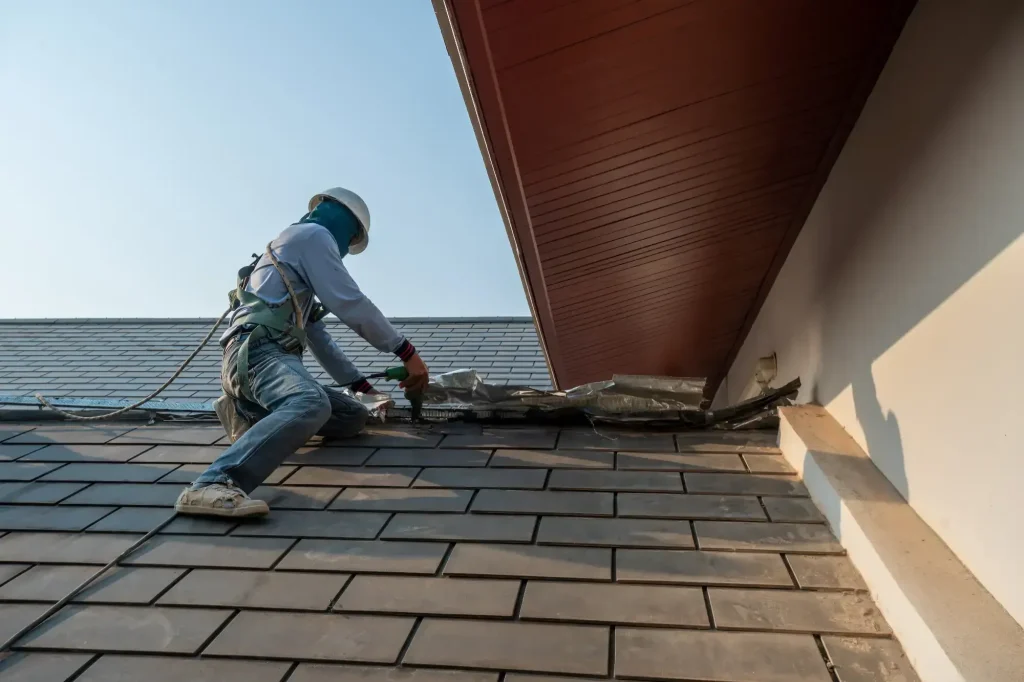
A real roof damage assessment is not a five-minute walk around your yard. A thorough inspection covers the entire exterior of the roof — field shingles, ridge cap, all flashing points, gutters, soffit, fascia, and any penetrations like vents, skylights, or chimneys. It also includes an interior check: attic insulation, decking condition, signs of existing moisture or mold, and the integrity of the roof structure itself.
After a storm, a qualified inspector is looking for specific evidence of storm-caused damage versus pre-existing wear. This distinction matters enormously for your insurance claim. Insurers will scrutinize the damage and look for signs that the roof was already in poor condition before the storm. A professional who knows how to document storm-specific damage patterns — hail bruising, wind-lifted tabs, impact marks on flashing — is doing work that directly affects your payout.
This is also where the age of your roof becomes relevant. Homes with roofs over 20 years old are statistically more likely to file a wind or hail claim — and insurers know this. If your roof is aging, the inspection report needs to clearly distinguish between storm damage and normal aging. An inspector who understands this distinction, and who documents it in writing with photographs, is protecting your interests at the claim stage.
The inspection report should be written, detailed, and specific. It should list every area of damage, describe the likely cause, and include photographs with clear labels. A contractor who hands you a one-page estimate without a damage narrative is giving you a quote, not an inspection. Those are different things, and when you’re dealing with an insurance claim, the difference matters.
Local Roofing Experts — What Separates the Good Ones
Beyond NJ registration, there are a handful of credentials that actually tell you something meaningful about a roofing contractor’s quality. GAF Master Elite certification, for example, is held by roughly 3% of roofing contractors in the United States. It requires ongoing training, demonstrated quality standards, and verified insurance coverage. It also enables the contractor to offer enhanced manufacturer warranties that non-certified installers simply cannot provide.
Manufacturer authorization matters for a related reason. When a contractor is an authorized installer for brands like Owens Corning, GAF, CertainTeed, or Ovation, the manufacturer stands behind the installation — not just the materials. That means if the shingles fail due to an installation defect, you have a path to recourse beyond just the contractor’s own warranty. For a homeowner in Marlboro or Colts Neck putting $10,000 to $15,000 into a replacement roof, that layered protection is worth understanding.
Labor warranties are where you really see the difference between contractors who believe in their work and those who don’t. A one-year labor warranty is the industry floor. A five-year warranty is common among established contractors. A 30-year labor warranty — which means the contractor will stand behind the installation for three decades — is rare and meaningful. It tells you that the contractor isn’t planning to be out of business next year, and that they’re confident enough in their workmanship to back it up in writing for the long haul.
Finally, there’s a real difference between a company where the owner shows up personally to assess the damage, explain the scope, supervise the crew, and answer your questions — and one where you meet a salesperson, sign a contract, and then deal with a rotating cast of subcontractors you’ve never met. The former is rarer than it should be. When you find it, it’s worth paying attention to.
Top Rated Roofing Companies — How We Work With Your Insurance
We understand that dealing with insurance after a roof emergency is stressful. That’s why we handle the documentation side of things — not just the repair. When you call us out for a roof damage inspection, we show up prepared to photograph, measure, and document exactly what the storm did to your home. We write detailed inspection reports that speak the language insurers understand, and we’re present during your adjuster’s inspection to answer questions and make sure nothing gets missed.
We’ve been working with homeowners in Monmouth and Bergen counties since 1990. We know how local adjusters think, what questions they ask, and what documentation makes the difference between a claim that gets approved and one that gets disputed. That experience is part of what we bring to the table.