
Summary:
Most homeowners don’t think about their roof until something goes wrong. Then suddenly you’re standing in your attic with a flashlight, water dripping somewhere it shouldn’t be, wondering whether you’re about to spend a few hundred dollars or fifteen thousand.
That uncertainty — not knowing whether you need a repair or a full replacement — is exactly what some contractors count on. Some will push you toward a replacement regardless. Others will patch something that should have been replaced two repairs ago.
This page is about helping you understand the difference before anyone shows up with a ladder. By the end, you’ll know what to look for, what questions to ask, and when it actually makes sense to call in a professional assessment.
Roof Repair vs. Replacement: How to Know Which One You Actually Need
The repair-or-replace question doesn’t have one universal answer — it depends on a combination of factors that, taken together, tell the story of where your roof actually stands.
Age is the starting point. Standard asphalt shingles have a lifespan of roughly 15 to 20 years for 3-tab styles and 25 to 30 years for architectural shingles. If your roof is past that window, individual repairs become less about fixing a problem and more about delaying the inevitable.
Extent of damage matters just as much. A single area of missing shingles after a storm is a very different situation from widespread granule loss, multiple soft spots in the decking, or flashing that’s pulling away in three separate places. The more the damage is distributed across the roof rather than concentrated in one spot, the stronger the case for replacement.
Then there’s repair history. If you’ve already had the same roof patched once or twice in the past few years, each subsequent repair carries diminishing returns. The components of an aging roof — shingles, underlayment, flashing, decking — age together as a system. Fixing one part while the rest continues to deteriorate is a cycle that tends to cost more in total than a well-timed replacement would have.
Concrete Tile Roof Repair: What's Different and When It Makes Sense
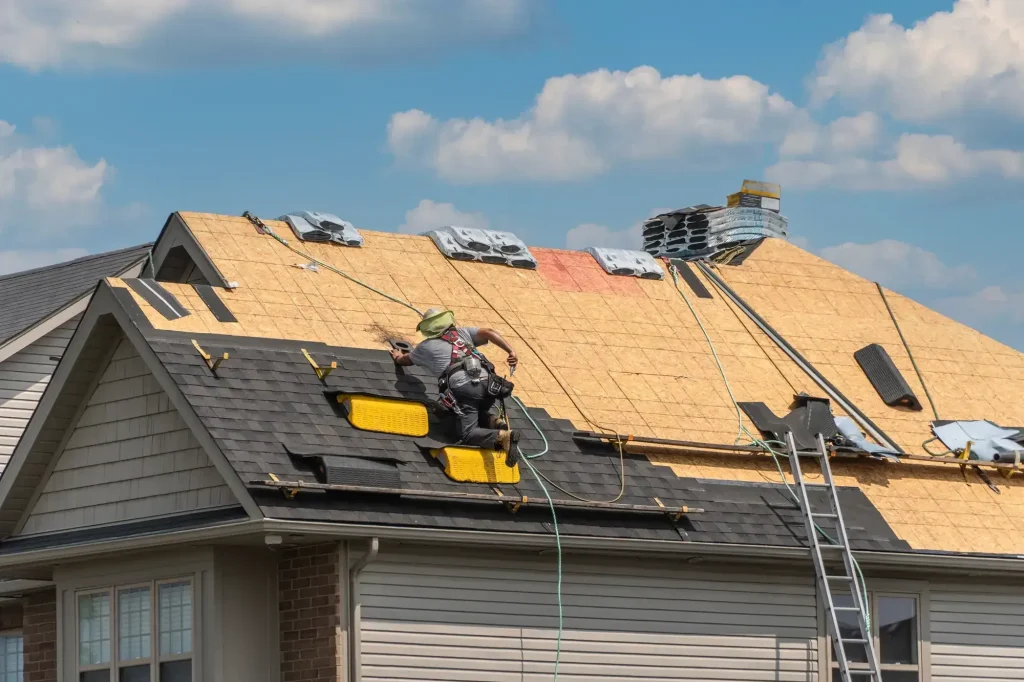
Concrete tile roofs are more common throughout Monmouth County than most people realize — particularly in communities like Colts Neck, Rumson, and Holmdel, where larger homes and higher-end construction are the norm. When a tile roof develops a problem, the repair-vs-replace calculus is a bit different from what you’d apply to a standard asphalt shingle roof.
The good news is that concrete tile itself is extraordinarily durable — it can last 40 to 50 years under normal conditions. The bad news is that the underlayment beneath it typically doesn’t. Most tile roofs in the 25-to-35-year range are not failing because of the tiles themselves. They’re failing because the underlayment has deteriorated, allowing water to get under the tiles and into the decking. In those cases, replacing a few cracked tiles without addressing the underlayment is a surface fix that doesn’t solve the actual problem.
Individual tile replacement makes sense when the damage is genuinely isolated — a few cracked or chipped tiles from impact, with no evidence of water intrusion into the underlayment or decking beneath. The critical qualifier is that the replacement tiles need to match the existing ones in profile, weight, and color. Tile profiles vary significantly between manufacturers and even between production runs from the same manufacturer. A contractor who doesn’t understand this will end up with a patchwork repair that doesn’t seal properly and looks mismatched from the street.
What separates a quality tile repair from a bad one is the inspection underneath. Any contractor working on a tile roof should be checking the condition of the underlayment and the decking, not just swapping out the visible tiles. If there’s moisture in the decking or the underlayment is crumbling, the conversation needs to shift from repair to partial or full replacement — and a contractor who doesn’t surface that finding isn’t giving you an honest assessment.
Not every roofing contractor has meaningful experience with tile roofs. Tile work requires different handling techniques, different fastening methods, and familiarity with the specific materials involved. Asking a contractor directly about their tile repair experience — and asking to see examples — is a reasonable step before you commit to anything.
24-Hour Emergency Roof Repair in Monmouth County
Monmouth County gets hit hard by weather. Nor’easters roll through in the winter and spring, tropical storms make appearances in late summer and fall, and the coastal communities along Route 35 and Route 36 — Keansburg, Keyport, Union Beach, Hazlet — are some of the most exposed in the state. When a storm tears off shingles or opens up a section of flashing at 11 PM on a Tuesday, the repair-vs-replace decision can wait. Stopping the water intrusion cannot.
Emergency roof repair is a two-step process, and understanding that distinction matters. The first step is stabilization: getting a temporary repair in place quickly enough to prevent water from continuing to enter the structure. This typically involves tarping the affected area, securing loose or missing shingles, and addressing any open penetrations that are letting rain in. It’s not the permanent fix — it’s damage control while conditions allow for proper assessment and repair.
The second step is the permanent solution, which gets scheduled as soon as weather permits and a full inspection can be completed safely. That inspection needs to happen both on the roof surface and in the attic. Surface damage is often the visible indicator of something more significant happening underneath — saturated insulation, wet decking, or moisture that’s been working its way in through a compromised area for longer than the most recent storm. A ground-level look or a quick surface scan won’t catch those things.
If you’ve had storm damage, your homeowner’s insurance policy may cover some or all of the repair cost depending on the cause and extent of the damage. A reputable contractor will document the damage thoroughly — photos, written assessment, material quantities — in a format that supports an insurance claim. That documentation step is part of the emergency response, not an afterthought. If a contractor shows up, puts a tarp on, and leaves without giving you anything in writing, that’s a gap worth noticing.
After major weather events in Monmouth County, the area tends to see an influx of out-of-state contractors soliciting work door-to-door. Some are legitimate. Many are not. New Jersey requires all roofing contractors to be registered as Home Improvement Contractors (HIC) with the Division of Consumer Affairs — and that registration number must appear on any contract or proposal. You can verify any contractor’s registration at njconsumeraffairs.gov before you sign anything. It takes about two minutes and it matters.
How to Vet a Roofing Contractor in New Jersey Before You Commit
Once you’ve got a sense of whether you’re looking at a repair or a replacement, the next question is who to trust with the work. In New Jersey, roofing contractors are required to carry a Home Improvement Contractor (HIC) registration through the Division of Consumer Affairs. That registration number needs to appear on every contract and proposal — and if a contractor can’t produce it or gets vague when you ask, that’s a clear signal to keep looking.
Beyond licensing, ask about general liability insurance and workers’ compensation coverage. Workers’ comp matters specifically because if a worker is injured on your property and the contractor doesn’t carry it, you can be held liable. These aren’t bureaucratic details — they’re the baseline of what separates a legitimate contractor from someone who’s cutting corners in ways that could cost you significantly more than the roof job itself.
What GAF Certification Actually Means for Your Roof

GAF is the largest roofing manufacturer in North America, and their certification program is one of the few third-party credentials in the residential roofing industry that actually requires something meaningful to earn. Only about 3% of roofing contractors nationwide qualify for GAF certification — it requires verified licensing and insurance, a demonstrated track record of quality work, and ongoing training requirements. It’s not something you can buy or self-report.
For homeowners, GAF certification matters for one concrete reason: it unlocks access to enhanced warranty programs that go beyond the standard manufacturer material warranty. A standard material warranty covers the shingles themselves if they fail due to a manufacturing defect. Enhanced warranty programs — the kind that only GAF-certified contractors can offer — extend coverage to include the full roofing system and, in some tiers, the labor as well. That’s a meaningfully different level of protection.
The distinction becomes most relevant when something goes wrong years down the line. A standard warranty might cover the cost of replacement shingles but leave you on the hook for the labor to install them. An enhanced system warranty covers the whole picture. For a roof that’s supposed to last 25 to 30 years, that difference in coverage is worth understanding before you choose a contractor based on price alone.
We hold GAF certification — and we mention it not to stack credentials but because it has a direct, practical effect on the warranty options available to you as our customer. When we install a new roof, you’re not limited to what the shingle manufacturer covers. You have access to warranty programs that treat the roof as a system, which is how it actually functions.
GAF certification requires contractors to maintain their standing — it’s not a one-time achievement. That ongoing accountability is part of what makes it a meaningful signal rather than a marketing badge.
Why We'll Tell You When You Don't Need a New Roof
There’s a fear that runs through almost every conversation we have with homeowners who’ve already gotten one or two contractor opinions: “Am I being told I need a replacement because I actually need one, or because that’s the bigger job?” It’s a fair question. And honestly, the roofing industry hasn’t always done a great job of earning the benefit of the doubt on that one.
Here’s where we stand: we’re not going to sell you a replacement if a repair will handle it. But we’re also not going to patch a roof that’s failing when what you actually need is something that’ll last. Both directions of that commitment matter. A contractor who only pushes repair is leaving you exposed. A contractor who only pushes replacement is leaving money on your table. Neither serves you well.
In practice, this means our assessments are honest about the math. If your roof is 12 years old, the damage is isolated to one section, and the decking underneath is solid, a repair is the right call — and that’s what we’ll tell you. If your roof is 24 years old, you’ve had it patched twice in the last four years, and the granule loss is widespread, we’ll tell you that too — along with the honest reason why another repair is likely to cost you more over the next three years than a replacement would cost today.
The homes in Freehold, Hazlet, Matawan, and Aberdeen that were built in the 1960s and 1970s are squarely in that second category right now. A lot of Monmouth County housing stock is at or past the end of its original roofing system’s useful life, and the question isn’t really if a replacement is coming — it’s whether the timing makes sense to act now or whether a targeted repair buys meaningful time. That’s a real conversation, and it’s one we’re willing to have without steering you toward the answer that benefits us most.
We’ve been doing this in Monmouth County for over 40 years. The owner shows up at every job — not a foreman, not a crew lead. That’s not a marketing line; it’s how we’ve run the business since the beginning. When your name is on the work, you care about it differently. Our license number is #13VH13248500, verifiable through the NJ Division of Consumer Affairs. We carry full general liability and workers’ compensation coverage. And every job we do is backed by a 30-year labor warranty — because we stand behind what we install.
Ready to Get a Straight Answer About Your Roof?
The repair-vs-replace decision doesn’t have to be a guessing game — and it shouldn’t be something you figure out only after a contractor has already told you what they want to do. Understanding the key factors ahead of time: age, damage extent, repair history, and the cost-efficiency threshold where patching stops making sense, puts you in a position to evaluate what you’re being told and ask the right questions.
If you’re in Monmouth County and you’re not sure where your roof stands, the most useful next step is a real inspection — on the roof surface and in the attic — not a driveway glance and a ballpark number. That’s the only way to know what you’re actually dealing with.
A Russo Roofing & Siding offers same-day free estimates, and we’re available Monday through Sunday if you need to move quickly. If there’s active damage, our emergency response is available around the clock. Reach out when you’re ready — we’ll give you an honest read on what your roof actually needs.