Summary:
Your roof shingles take a beating in New Jersey. Coastal winds, nor’easters, summer heat, and freeze-thaw cycles all work against the materials protecting your home. When shingles fail, water gets in—and that’s when repair bills start climbing.
If you’re trying to figure out which shingles actually last in Monmouth County weather, what a replacement should cost, or whether your current roof needs work, you’re dealing with questions that affect both your budget and your family’s protection. This guide walks through the shingle types that perform in New Jersey conditions, the costs you’ll actually face, and the warning signs that mean it’s time to take action.
Roofing Materials Comparison for New Jersey Homes
Not all roof shingles perform the same way in New Jersey. The materials that work fine in Arizona or California might not hold up to the weather patterns hitting Monmouth County every year.
Asphalt shingles dominate residential roofing across New Jersey because they balance cost, performance, and availability. Within that category, you’ll find architectural shingles and 3-tab shingles—two options with very different lifespans and price points. Metal roofing has gained ground among homeowners who want longer-term durability and better performance during heavy snow. Slate and tile show up on higher-end homes, offering decades of protection but requiring structural support and a bigger upfront investment.
The choice comes down to how long you plan to stay in your home, what your roof can structurally handle, and how much weather exposure your property faces.
Architectural Shingles vs 3-Tab Shingles

Architectural shingles use a thicker, multi-layer design that creates depth and shadow lines on your roof. They’re engineered to resist wind uplift better than 3-tab shingles, which matters when coastal storms push through Monmouth County. Most architectural shingles carry wind resistance ratings up to 130 mph and come with longer manufacturer warranties—often 30 years or more.
3-tab shingles sit flat and uniform across your roof. They cost less upfront, which makes them attractive when budget is tight. The tradeoff shows up in lifespan and durability. In New Jersey’s climate, 3-tab shingles typically last 15-20 years before needing replacement, while architectural shingles can reach 25-30 years with proper installation and maintenance.
The price difference between the two runs about $1-2 per square foot installed. For a typical 2,000 square foot roof in Monmouth County, that translates to roughly $2,000-$4,000 more for architectural shingles. That extra cost buys you an additional 5-10 years of protection and better performance during the storms that hit this area every year.
Architectural shingles also add visual appeal. The dimensional look mimics higher-end materials like wood shake or slate, which can boost curb appeal if you’re thinking about resale value down the road. Neighborhoods with newer construction or recent updates tend to favor architectural shingles, and going with 3-tab in those areas can make your home stand out in the wrong way.
When we recommend architectural shingles for New Jersey homes, it’s not upselling—it’s acknowledging that the weather here demands materials built to handle wind, ice, and temperature swings that wear down lighter options faster.
How New Jersey Weather Affects Roof Shingle Lifespan
Freeze-thaw cycles hit New Jersey roofs hard. Water seeps under shingles during rain or snow, then freezes overnight when temperatures drop. That expansion cracks sealant bonds and lifts shingle edges. Over years, those small failures compound into leaks and structural damage.
Coastal areas face additional stress from salt air and sustained winds. Properties near the shore deal with corrosion that accelerates wear on flashing and fasteners. Even a few miles inland, the wind patterns during nor’easters can strip poorly installed or aging shingles right off the roof.
Summer heat and UV exposure degrade the asphalt and cause granule loss. Those granules aren’t just cosmetic—they protect the underlying material from sun damage. When you see granules collecting in your gutters, it’s a sign that your shingles are losing their protective layer and approaching the end of their functional life.
Ice dams form when heat escapes through your attic and melts snow on the upper portions of your roof. That water runs down and refreezes at the eaves, creating a barrier that forces water back under the shingles. Proper attic ventilation and adequate insulation help prevent ice dams, but the shingle quality and underlayment also determine how well your roof resists the water intrusion when dams do form.
New Jersey’s weather doesn’t just shorten shingle lifespan—it tests every aspect of your roofing system. A roof that would last 30 years in a more moderate climate might only give you 20-25 years here. That’s not a failure of the materials; it’s the reality of what this climate demands from roofing systems.
Roof Replacement Cost in Monmouth County
Roof replacement costs in Monmouth County typically run $12,000 to $18,000 for architectural shingles on a standard 1,700-2,000 square foot home in 2026. That range includes tear-off, disposal, underlayment, new shingles, flashing, permits, and labor.
The wide range reflects differences in roof complexity, material choices, and what contractors include in their estimates. A simple ranch with minimal valleys and penetrations costs less than a two-story colonial with multiple dormers, skylights, and complex flashing details. Labor rates in New Jersey run 20-40% higher than the national average, which explains why estimates here exceed what homeowners in other states pay for similar work.
Material selection drives the biggest cost variation. Basic 3-tab shingles start around $3-$7 per square foot installed, while architectural shingles run $4.50-$7.50 per square foot. Premium options like metal roofing jump to $8-$16 per square foot, and slate can reach $15-$30 per square foot.
What's Included in a Roof Replacement Estimate

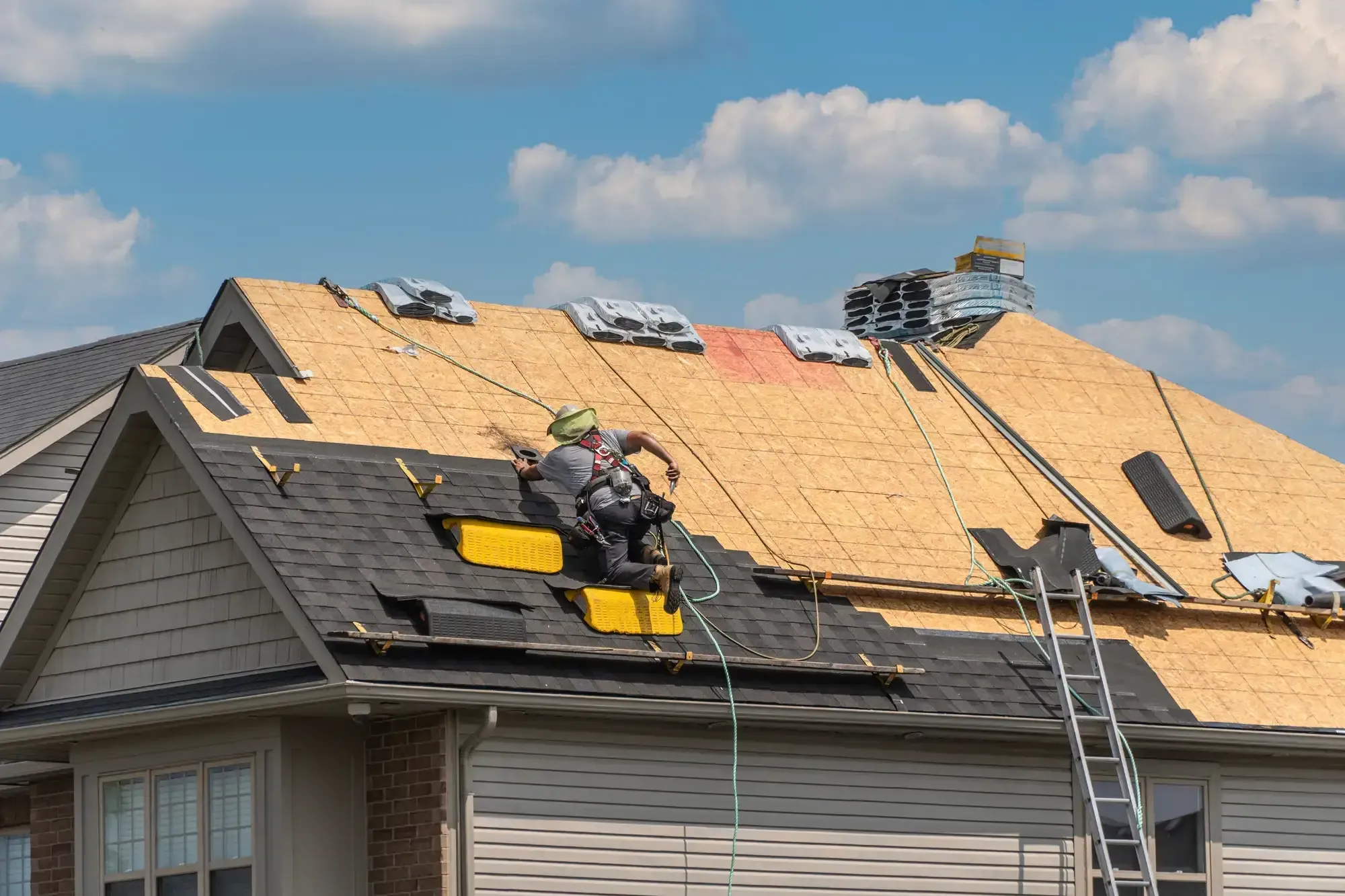
A complete roof replacement estimate should break down every component of the job. Tear-off and disposal cover removing your old shingles and hauling away the debris. That’s typically $1 per square foot, plus disposal fees. Some contractors try to save money by roofing over existing shingles, but New Jersey building codes and manufacturer warranties often require complete tear-off for proper installation.
Underlayment and ice-water shield protect your roof deck before shingles go on. Quality underlayment matters in New Jersey because it’s your second line of defense when wind-driven rain or ice dams push water under the shingles. Ice-water shield goes in valleys and along eaves where ice dams typically form. Cutting corners here leads to leaks that show up months or years after installation.
Flashing around chimneys, skylights, and roof penetrations needs replacement during a roof job. Old flashing often corrodes or loses its seal, and reusing it defeats the purpose of installing new shingles. Proper flashing installation requires skill and attention to detail—it’s where many leak problems originate when contractors rush through the work.
Ventilation upgrades should be part of the conversation. Ridge vents, soffit vents, and proper attic airflow extend shingle life and prevent ice dams. If your current roof lacks adequate ventilation, a replacement gives you the chance to fix that problem before it damages your new shingles.
Permits and inspections add to the cost but protect you legally. Every municipality in New Jersey requires permits for roof replacement. Contractors who offer to “skip the permit to save money” are setting you up for problems when you try to sell your home or file an insurance claim. Permitted work gets inspected, which means someone besides the contractor verifies the job meets code.
Warranty coverage varies by contractor and material choice. Manufacturer warranties cover defects in the shingles themselves, typically ranging from 25 years to lifetime depending on the product. Workmanship warranties cover installation errors and should come from the contractor. Many contractors offer 5-10 year workmanship warranties, though we stand behind our work with a 30-year labor warranty because we’re confident in our installation quality and plan to stay in business.
Roof Repair Cost vs Full Replacement
Roof repairs make sense when damage is localized and your roof is relatively young. Replacing a 10×10 section of damaged shingles typically costs $350-$800 depending on access and material matching. Flashing repairs run $200-$500 for most residential applications. Small leak repairs start around $150-$400 if caught early.
The math changes when repairs become frequent or widespread. If you’re fixing multiple leaks, dealing with extensive granule loss, or your roof is approaching 20 years old, replacement usually makes more financial sense than ongoing repairs. Putting $2,000-$3,000 into repairs on a roof that will need replacement within a few years just delays the inevitable while risking water damage to your home’s interior.
Age is the biggest factor in the repair-versus-replace decision. A 10-year-old roof with storm damage is worth repairing. A 22-year-old roof with the same damage probably isn’t, because you’re repairing shingles that are already near the end of their functional life. The new section won’t match the weathered appearance of the surrounding shingles, and the rest of the roof will likely start failing soon anyway.
Insurance claims add another layer to this decision. If storm damage is extensive enough to warrant a claim, insurance companies often prefer replacement over patchwork repairs—especially if the roof is older. They’d rather pay once for a complete replacement than deal with ongoing claims as different sections fail over the next few years. Working with a contractor experienced in insurance claims helps navigate that process and ensures you get appropriate coverage for the actual scope of damage.
The question isn’t just what needs fixing right now—it’s whether your roof can realistically give you another 5-10 years of reliable protection. If the answer is no, repairs become a short-term band-aid that costs money without solving the underlying problem.
Questions to Ask a Roofing Company Before Hiring
The roofing industry has earned a bad reputation in some circles because of contractors who cut corners, disappear mid-project, or deliver shoddy work. Asking the right questions upfront helps you identify contractors who operate professionally versus those you should avoid.
Start with licensing and insurance. In New Jersey, roofing contractors need a Home Improvement Contractor license. Ask for the license number and verify it through the state. Insurance should include general liability and workers’ compensation. Request certificates and call the insurance company to confirm coverage is current. If a worker gets injured on your property and the contractor lacks proper insurance, you could be liable.
Experience matters, but specifically local experience. A contractor who’s been working in Monmouth County for 20 years understands the building codes, weather challenges, and material requirements better than someone from out of state chasing storm work. Ask how long they’ve been in business locally and request references from recent projects in your area.